
MCM Ad Formats & Capabilities
Advertiser performance is retail media revenue
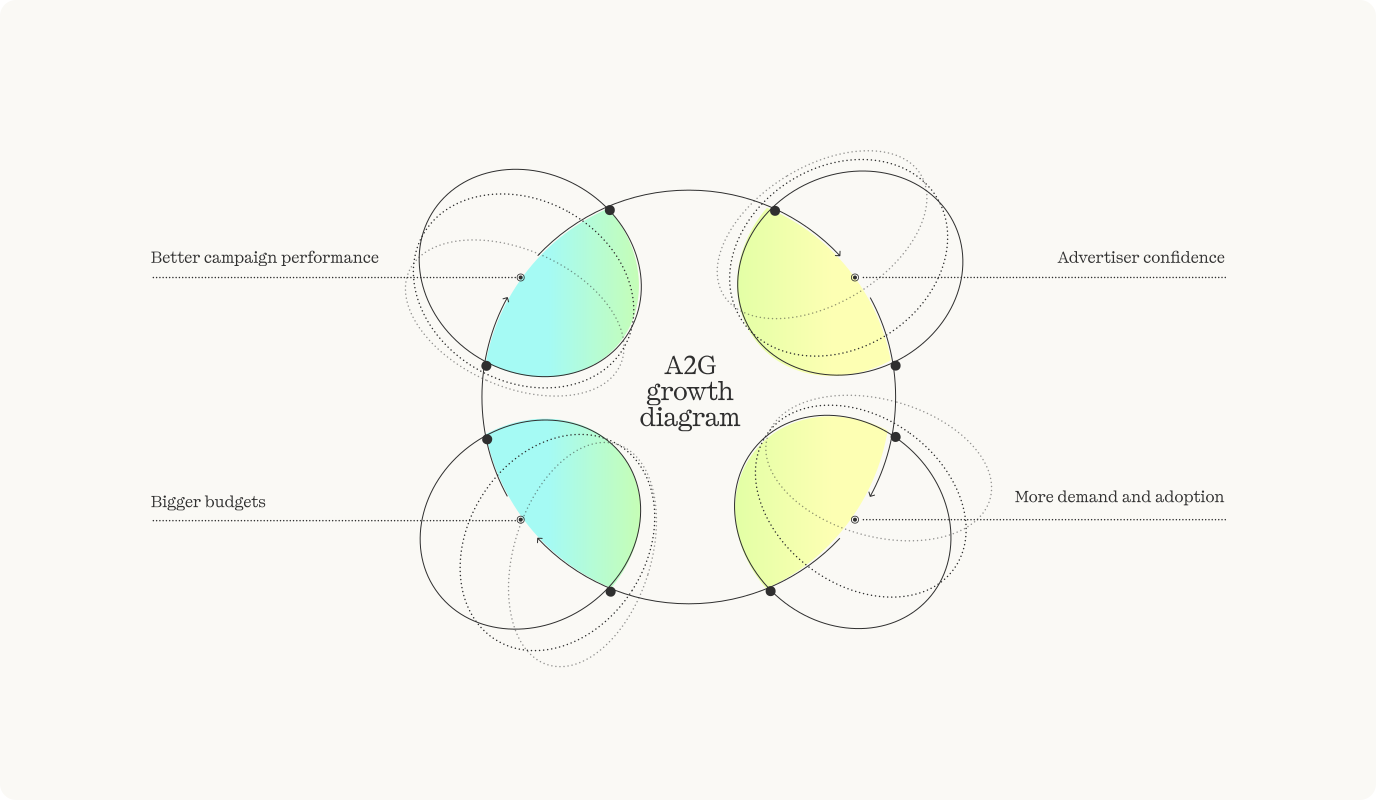
Moloco Commerce Media powers campaign performance at every stage of the funnel, from high-intent search to brand sponsorships. Better results mean bigger budgets. Bigger budgets mean more ad revenue as a percent of GMV (A2G).
Moloco’s customers include:







Retail media businesses can hit a ceiling early
The difference between platforms that break through and those that don't comes down to one thing: whether advertisers see results worth reinvesting in.
Advertisers have options — and they follow performance
Advertisers allocate budgets to channels that prove results. If your platform can't demonstrate measurable ROI, budgets go elsewhere. This isn't a sales problem. It's a performance infrastructure problem.
Outcomes can win more budget
Many retail media platforms lead with a list of ad formats. But advertisers buy results, not formats. Having Sponsored Products, Sponsored Brands, and Display only matters if the campaigns running on them perform.
Without the right AI, A2G stalls
Many platforms stay below 1% A2G. The difference between those that break through and those that don't isn't inventory or ad load. It’s whether the underlying technology can turn shopper signals into outcomes advertisers can measure and reinvest in. {[data-attribute="init-tooltip"][tooltip-content="<p>Source:<br><br>Moloco internal data, as of April 2026. A2G (advertising spend as a percentage of gross merchandise value, "GMV") is measured as total ad spend / total GMV during weeks 3-6 following each customer's commercial launch on Moloco MCM (their first billing date), excluding the first two weeks to remove soft-launch ramp. Sample: 24 MCM customers, measured at the contractual-customer level, that had completed six weeks of activity by April 2026. The substantial majority began below 1% initial A2G.</p>"]}
Your ad business grows when your advertisers do
Retail media has one reliable law: advertisers reinvest where they see returns, and move their money when they don’t. That makes advertiser performance the engine of your ad business — not inventory, not ad load, not sales headcount.
Most retailers start on MCM below 1% A2G. The ones that break through don’t do it by showing more ads. They do it by making every campaign their advertisers run perform well enough to justify the next investment. {[data-attribute="init-tooltip"][tooltip-content="<p>Source:<br><br>Moloco internal data, as of April 2026. A2G (advertising spend as a percentage of gross merchandise value, "GMV") is measured as total ad spend / total GMV during weeks 3-6 following each customers commercial launch on Moloco MCM (their first billing date), excluding the first two weeks to remove soft-launch ramp. Sample: 24 MCM customers, measured at the contractual-customer level, that had completed six weeks of activity by April 2026. The substantial majority began below 1% initial A2G.</p>"]}
Every stage of the funnel. One platform.
Turn high-intent traffic into advertiser results
Your search and browse surfaces can offer some of the most valuable ad inventory. Sponsored Products converts that intent into measurable advertiser outcomes. Where traditional keyword-based approaches rely on static matching, Moloco's AI predicts purchase intent from behavioral signals and shopper context, selecting products more likely to earn a click and a conversion. Relevant ads get results for advertisers without disrupting the shopping experience.
Bidding that buys outcomes
Advertisers choose how they buy. Target ROAS holds delivery to a stated return goal. MaxSales takes a budget and maximizes attributed sales against it. Fixed CPC gives precise cost control and works from day one, before the models have conversion history. As campaigns mature, advertisers graduate from manual control to outcome-based automation.
Relevance shoppers actually appreciate
Personalized, relevant ads help shoppers discover products they’re looking for, so performance and shopper experience rise together rather than trading off.
Evidence advertisers can act on
In Q1 2026, advertisers achieved an average ROAS of 1,100% for sponsored products across platforms and verticals. {[data-attribute="init-tooltip"][tooltip-content="<p>Source:<br><br>Moloco internal data for average ROAS for sponsored product campaigns in Q1 2026. Calculated as the sum of total attributed revenue across MCM divided by the sum of ad spend for retailers active over the whole quarter. Retailers are considered active if they have non-zero ad spend throughout the quarter. ROAS is calculated using each retailer\'s own attribution configuration, including direct and indirect (halo) attributions where reported. Attribution logic, including windows and types, varies across retailers. Results reflect a mix of business models and verticals.</p>"]}

Give advertisers a reason to bring their brand budgets to you
Once advertisers trust your platform with performance budgets, the next tier is brand and consideration spend, typically going to channels that pair reach with evidence. Sponsored Brands and Sponsored Display extend advertiser presence beyond search, running on the same AI that drives your Sponsored Products so brand placements stay relevant to the shopper in front of them.
Brand placements in the shopping journey
Display and brand-level units run across high-visibility onsite surfaces, available on CPC or CPM, letting advertisers build consideration where shoppers are already browsing.
Shopper behavior that surfaces better placements
Audience targeting is built on behavioral signals from your own platform: the segments only you can construct, informed by how shoppers actually browse and buy.
Familiar levers for sophisticated buyers
Keyword and placement targeting give advanced advertisers and agencies the controls they look for from established retail media channels, lowering the barrier to bringing existing playbooks and existing budgets to your platform.
Bring your direct-sold business onto the same engine
Enterprise brand deals don't run through self-serve auctions. They're sold on insertion orders with committed placements. Reserved Display brings that business onto the same platform as your auction demand, unifying impression-guaranteed buys, Cost-Per-Time sponsorships, and performance campaigns under shared infrastructure and measurement.
Guaranteed reach for committed budgets
Offer Impression-guaranteed and time-based (CPT) buying for the brands that plan quarters ahead and pay for certainty.
Direct sales and auction demand, one system
Your ad sales team sells sponsorships; your long tail self-serves performance campaigns. Both run on shared infrastructure, measurement, and controls.
Sophisticated budgets go where results can be verified
Moloco Commerce Media closes the loop from impression to purchase: SKU-level attribution over a configurable window, direct and total ROAS across an advertiser’s catalog, and reporting broken out by the dimensions buyers actually plan against. For the platforms and brands that demand more, our holdout-based incrementality framework can help quantify the effectiveness of ads for the platform and for advertisers.
SKU-level details
Attribution at the item level captures direct conversions and same-account halo purchases so ROAS claims hold up to a brand's own analytics team.
Forecasts before the commitment
Pre-launch estimates of impressions, clicks, and purchases, plus guidance on budgets and targets, reduce abandoned setups and misconfigured campaigns.
Reporting that builds advertiser confidence
Reporting is broken out by the dimensions advertisers actually plan against — SKU, campaign, audience, and time period — so performance conversations move from "trust us" to "here's the data."

Every format improves because the same intelligence powers all of them
Your dedicated models update every two hours, learning from actual results to stay accurate as shopper behavior shifts. The system makes over 190 billion real-time predictions a day across the platform, delivering personalized ads with a response time under 100ms for 95% of requests. That’s fast enough that you don't have to sacrifice load time for monetization. And it’s built entirely on first-party data: no third-party cookies, without pooling data across retailer environments. Just your data, working only for you. {[data-attribute="init-tooltip"][tooltip-content="<p>Source:<br><br>Moloco internal data. Analysis of machine learning (ML) model predictions executed in real time while serving ad requests during the week of June 1 to June 7, 2026. ML prediction counts are derived from auction records rather than measured directly: each ad request invokes one user-context model inference, and each ad evaluated in an auction invokes a fixed number of scoring inferences determined by its ad format. Sponsored Product ads invoke two scoring inferences per ad evaluated, one click-through-rate (CTR) and one conversion-rate (CVR) prediction; all other ad formats are counted with one inference per ad candidate, the most conservative estimate. Only inferences executed in real time at request serving are counted; computations performed in advance of ad requests are excluded. Figures are based on sampled internal auction logs (10% sample, scaled accordingly) and averaged to a daily figure.</p>"]}
Optimization without the ops burden
Our AI automates keyword targeting, product selection, bid management, and campaign optimization — continuously, without manual intervention. As your catalog changes, categories launch, or seasonal dynamics shift, the system adapts automatically.
Serving that protects the shopper
Ad quality algorithms throttle low-relevance ads and filter weak matches out of search results, so yield can grow while protecting the shopper experience.
Scale you don’t have to manage
Our infrastructure scales automatically with inventory growth, catalog expansion, and traffic spikes, including high-concurrency events — all without manual management.
Frequently Asked Questions
What ad formats does Moloco Commerce Media support?
Moloco supports sponsored products, sponsored brands, display, and video advertising across the shopping journey. These formats can run across search, browse, discovery, and other onsite placements.
Because the formats operate through the same AI system, learning from one part of the advertising business can improve decisions elsewhere.
How is Moloco different from a rules-based sponsored products platform?
Legacy platforms match queries against static keyword lists and require manual inputs and interventions to adjust campaign settings. Moloco’s AI predicts purchase intent from behavioral signals and shopper context, and outcome-based bidding (Target ROAS, MaxSales) optimizes delivery against the goals advertisers actually have. The practical difference: advertisers manage a business outcome, not a bid sheet.
Do advertisers run campaigns themselves?
Yes. Advertisers launch and manage campaigns, while you retain governance through roles, permissions, provisioning, and creative review. Self-serve is what lets advertiser adoption scale without linear ad ops growth.
How does Moloco Commerce Media protect retailer data?
Each platform’s models are trained exclusively on that platform's own data within an isolated environment, and Moloco’s on-site architecture is built entirely on first-party data. We take data and security seriously. For full details on data architecture and security practices, visit our Trust Center.
Can Moloco work alongside our existing ad tech or in-house system?
Yes. Flexible deployment options — auction infrastructure only, bring-your-own models, or the full Moloco AI stack — let you adopt what fits your roadmap today and expand later. And with an API-first integration model, Moloco works whether you're replacing a platform, supplementing an in-house build, or launching net-new.
