Moloco’s advertising intelligence
CARA (Compound Ad Recommendation Architecture) coordinates models and agents across commerce media domains — turning shopper, advertiser, and retailer signals into better advertising decisions across the whole system.
Commerce media has three outcomes to optimize
Every ad decision has to produce three results at once: a shopper who finds something worth buying, an advertiser who gets a return on the spend, and a retailer who earns revenue without degrading the store. The decision is never a single objective, and it has to be resolved in milliseconds, on a catalog, taxonomy, audience, placement structure, and commercial model that is different for every retailer.
CARA coordinates and optimizes all three.
CARA brings together signals, personalization, bidding, ad serving, demand activation, and campaign automation. It learns from each retailer’s first-party data to make real-time decisions that balance the three outcomes a commerce media business depends on — improving shopper relevance, advertiser performance, and retailer monetization, together.
The architecture of compound intelligence
CARA is compound by design, bringing models, agents, and specialized software together across six connected technical domains to share signals and learning. Its predictive models learn what is likely to happen, while its agentic layers help turn that intelligence into actions.
Because signals and learning move across the architecture, an improvement in one domain can strengthen decisions throughout the system.
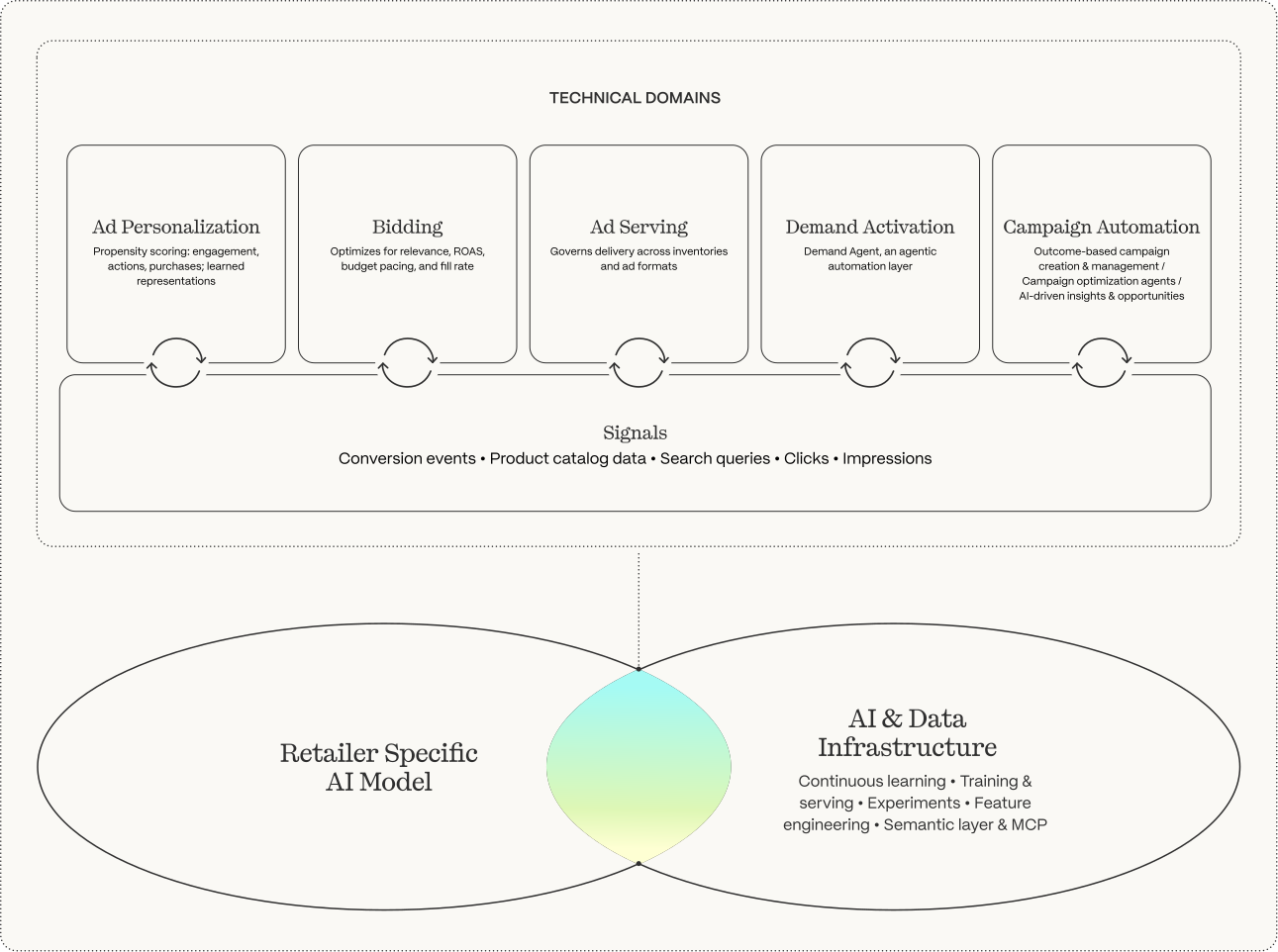
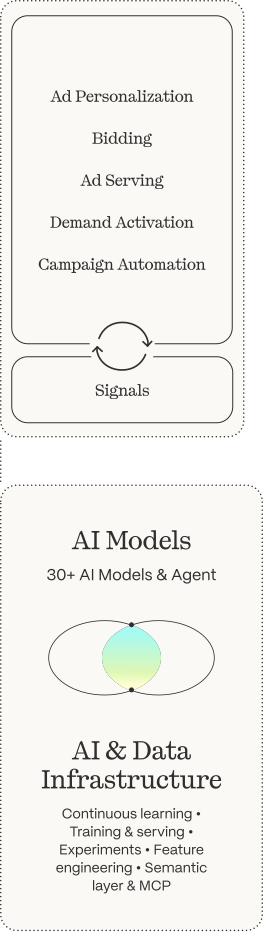
How CARA’s six domains work together
The six technical domains are built to navigate the complexities of commerce media. They work in concert to achieve outcomes, with learning compounding over time across the system.
Signals
Turn every signal a retailer already has into one connected business view
A retailer's signals start out scattered: catalog attributes, search queries, impressions, clicks, and conversion events, each in its own system. CARA connects them into a single intelligence layer for that retailer. Each retailer gets its own. Models are trained exclusively on that retailer's data, in an isolated environment, and nothing is pooled across retailers.
Inside that layer, semantic matching works across messy catalog structures, which reduces the dependence on hand-maintained taxonomy. How far it gets depends on catalog completeness and data quality.
The more accurately CARA understands a retailer's catalog and shoppers, the sharper its personalization, retrieval, relevance, and bidding become.
Ad Personalization
Make ads more relevant
For each eligible ad slot across search results, product detail pages, category pages, and other onsite ads placements, CARA predicts which ads are most relevant to the individual shopper.
Its deep-learning models combine shopper behavior, search intent, catalog attributes, and placement context to predict click and conversion probability for each available ad candidate. Because products are understood through semantic relationships rather than click history alone, newer items can inherit relevance signals from similar products.
This helps sellers promote products with little or no performance history while giving new and returning shoppers more relevant sponsored results from the start.
Bidding
Balance every bid across all three outcomes
CARA applies first-party conversion data and domain-specific bidding logic to optimize each commerce media auction across three connected outcomes: shopper relevance, advertiser ROAS and budget delivery, and retailer revenue and inventory fill.
The system evaluates the value of each eligible impression individually, then adjusts bids and pacing in real time. CARA adjusts bids and pacing automatically as demand shifts, reducing reliance on manual campaign updates.
This helps retailers capture more value from eligible inventory while advertisers stay aligned with their performance goals and budgets.
Add Serving
Monetize more placements without losing relevance
CARA manages ad serving across retailer-owned surfaces, including search results, product detail pages, category pages, and other onsite ad placements and formats.
Because every placement plays a different role in the shopping journey, CARA evaluates its effect on auction density, ad exposure rate, relevance, and expected revenue. It uses that placement-level intelligence to decide what to serve, where, and when — helping retailers increase retail media monetization without overwhelming shoppers or degrading the experience.
Each new placement also produces behavioral signals. As CARA learns from more of the customer journey, its decisions about inventory, delivery, and relevance become more precise.
Demand Activation
Scale advertiser demand without scaling operations
Inventory alone can’t build a scalable commerce media business. Retailers also need suppliers ready to invest in advertising. Yet many suppliers hesitate because they lack proof of performance, worry about margin erosion, or see retail media advertising as complex and difficult to operate.
CARA’s Demand Agent is an agentic automation layer designed to help retailers identify and activate high-potential advertisers. It uses catalog and platform data to identify promising suppliers, generate ready-to-launch campaign recommendations, and prompt outreach at relevant lifecycle moments.
Campaign Automation
Turn advertiser goals into continuous optimization
Advertisers define the outcomes that matter to them, such as a ROAS target, sales goal, budget, or pay-per-order objective. CARA then coordinates product selection, bidding, pacing, and delivery around the chosen campaign goal.
CARA’s agentic campaign automation monitors live campaigns continuously, identifying underspend, targeting gaps, and other opportunities to improve performance. Specialized agents apply or recommend actions using dedicated bidding and pacing logic for each campaign objective.
Real-time dashboards keep performance visible, while specialized agents reduce the manual work of monitoring and optimization. Your sellers get more help running effective campaigns, while your team can grow campaign volume without adding operational work at the same rate.
How the system compounds
Better signals enable better predictions.
Richer shopper, item, and catalog data improve personalization and bidding. CARA gets better at predicting what to show, where to show it, and what each opportunity is worth.
Better decisions strengthen performance.
Stronger bidding fills more valuable placements while protecting advertiser ROAS and shopper relevance. Improved performance gives suppliers more reason to invest and retailers more confidence to expand supply.
More demand deepens the system.
As more suppliers advertise, auction density grows. CARA can choose from a broader set of eligible products, improve fill rate and serve more relevant ads.
Every outcome becomes new intelligence.
Impressions, clicks, conversions, budgets, and catalog performance feed back into CARA’s models and agents, sharpening the next decision.
This system creates key conditions for A2G — the advertising revenue as a percentage of retailer's GMV — to compound.
Every campaign, placement, item, shopper interaction and advertiser outcome strengthens the intelligence behind the next one.
Frequently Asked Questions
What is CARA?
CARA, or Compound Ad Recommendation Architecture, is Moloco’s innovative AI system for coordinating commerce media decisions across signals, personalization, bidding, ad serving, demand activation, and campaign automation. Built by domain experts, its interconnected models and agents learn from retailer-specific data so improvements in one area can strengthen decisions across the wider system.
What does “compound AI” mean — and how does it work?
Compound AI means that multiple specialized models, agents, and software systems work through a shared architecture rather than operating as separate features.
Within CARA, for example, better product understanding can improve personalization, stronger personalization can improve bidding, and better campaign outcomes can create new signals for the next decision.
How does CARA work for commerce media?
CARA uses a retailer’s first-party commerce data to predict which ad, product, placement, and bid are most likely to create value for each eligible impression. It learns from catalog data, searches, impressions, clicks, conversions, budgets, and campaign outcomes, then coordinates decisions across the whole commerce media system in real time.
What first-party data does CARA use?
CARA can learn from retailer-owned signals including product catalog attributes, searches, impressions, clicks, add-to-cart events, purchases, prices, availability, and campaign outcomes. The exact data used depends on the retailer’s integration, policies, consent framework, and available signals.
Does CARA use the same model for every retailer?
No. CARA adapts to each retailer’s catalog, taxonomy, shopper behavior, placements, advertiser base, and commercial objectives. Retailer-specific signals allow the system to learn within each business’s operating environment rather than applying one fixed model to every marketplace. Each retailer's models train on its own first-party data in a dedicated instance; no data is shared across retailers.
How does CARA automate commerce media campaigns?
CARA automates product selection, bidding, pacing, delivery, and campaign monitoring around objectives set by the advertiser. Specialized agents can identify underspend, targeting gaps, and other opportunities, reducing manual work while keeping advertisers and retailers in control of goals and governance.
How does CARA help activate more advertisers?
CARA’s Demand Agent identifies sellers with strong advertising potential and creates campaign recommendations using catalog and platform data. This can help retail media teams focus outreach, reduce the effort required to launch campaigns, and increase seller participation without expanding operations at the same rate.
How often does CARA learn and update?
CARA learns continuously from new events, with updated model versions deployed as often as every two hours. Real-time decisions use the latest available models and signals, while deployment frequency can vary by model, domain, and operational requirements.
Build a commerce media system that improves with more signals
Bring your shopper data, advertiser goals, and retail environment together — and see what happens when intelligence compounds.
