
Moloco commerce media AI engine
The ad engine built to grow your ad business
Moloco Commerce Media is an AI-native advertising system that analyzes signals from millions of shoppers alongside catalog data to deliver relevant, high-performing ads. It optimizes every auction for shoppers, advertisers, and commerce platforms in milliseconds.
Moloco’s customers include:








Retail media goes only as far as the technology it's built on.
The difference comes down to how the system was designed
Rules-based systems can hit a ceiling
Static keyword lists that can't learn from shopper behavior
Manual configuration that requires human intervention to adjust
Relevance plateaus as catalog and demand complexity grows
Built differently, from the ground up
Treat every ad decision as a machine learning prediction problem
Train on the retailer's own first-party data
Close the loop from impression to purchase so the system learns from real outcomes
A prediction system designed to improve with every impression
What makes commerce uniquely powerful for advertising is the signal. Impressions, clicks, add-to-cart activity, and purchases all happen within one environment — creating a rich foundation for prediction that improves with every interaction. Models train on platform-specific behavior and score against actual shopper outcomes.
Your data, connected your way
Catalog and shopper data connect through:
- Flexible catalog ingestion for single- and multi-seller platforms and existing Google and Meta feeds
- Shopper-event streaming through APIs, tag managers, or existing CDPs
Learning that doesn’t go stale
Models stay current by:
- Retraining every two hours {[data-attribute="init-tooltip"][tooltip-content="<p>Source:<br><br>Moloco Internal Data. Update frequency is measured by model-retraining cadence as of April 2026.</p>"]}
- Adapting as behavior, inventory, and promotions shift throughout the day

Retailer-specific models and training
Each retailer environment includes:
- Dedicated model instances
- Model training using only the retailer’s own data
The closed loop
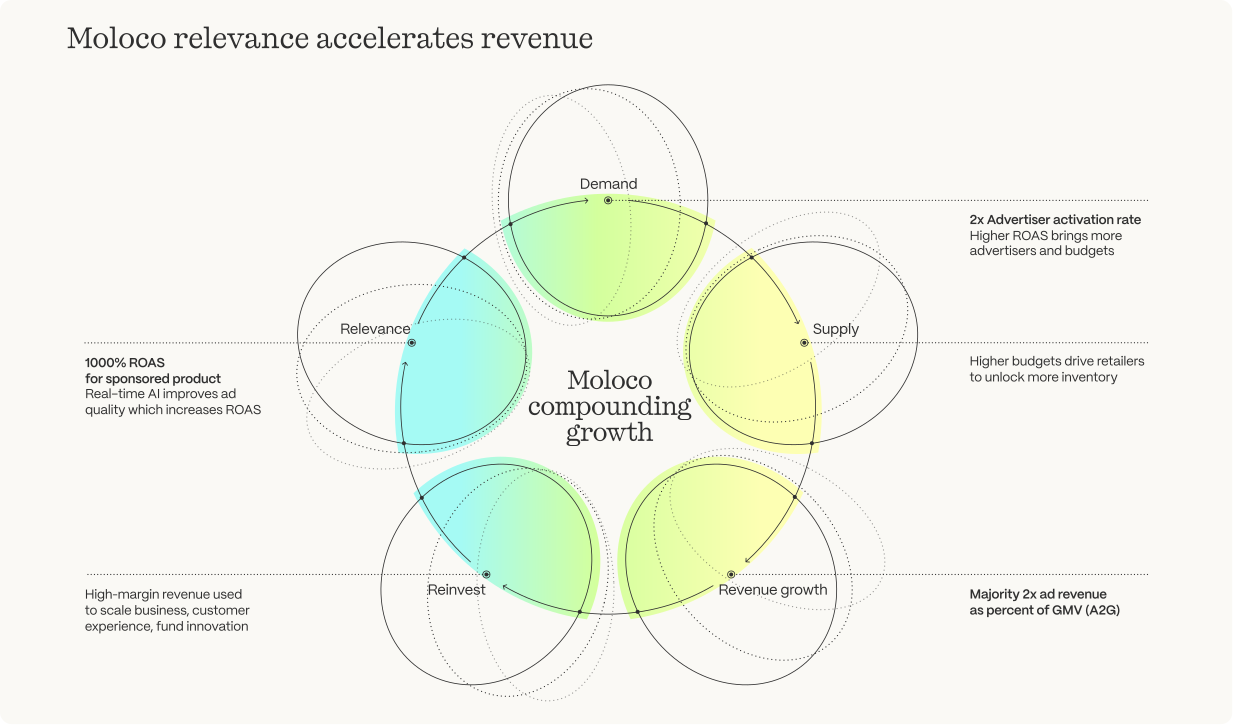
The closed loop is a flywheel you own: your shoppers generate the signal, your models capture it, your ad business compounds on it.
One decision is easy. Six domains deciding together is what compounds.
A commerce ad platform doesn't make one kind of decision — it makes six, simultaneously, on every request. CARA (Compound Ad Recommendation Architecture), Moloco's AI system, orchestrates models and agents across all of them to drive a three-way win for retailers, advertisers, and shoppers. It is the intelligence layer behind A2G growth — and each domain makes the others better: sharper catalog understanding improves retrieval; better retrieval improves bidding; better outcomes activate more advertisers; more advertisers deepen the auction and the signal.
That compounding is what "compound AI system" means in practice.
Campaign Automation
Advertisers state a goal (ROAS target, sales goal, budget); the system runs it, with agents monitoring live campaigns and surfacing recommendations.
Ad Personalization
Transformer-based models form dense representations of shopper behavior and product fit, predicting clicks and conversions per impression.
Bidding
Monetizes every impression with a relevant candidate — balancing shopper relevance, advertiser ROAS, and platform fill.
Signals
Normalizes catalog and behavioral data into embeddings, without manual taxonomy or keyword mapping.
Ad Serving
Governs ad delivery across owned surfaces, quantifying each placement's impact on auction density, exposure, and revenue.
Demand Activation
Demand Agent turns suppliers into advertisers with pre-configured, ready-to-launch campaigns.
The problems that break rules-based systems are the ones we built for
Serving an ad against an exact keyword match for a logged-in, frequent shopper is the easy case. Commerce is mostly the hard ones — and that's where an architecture actually gets tested.
Catalog understanding without taxonomy
Every retailer is its own world — different schema, taxonomy, and layout, with millions of items changing price and availability intraday. CARA encodes catalog attributes into embeddings that capture item relationships and semantic matches, so every downstream domain works from a sharper picture of the catalog.
Retrieval and scoring at auction speed
A two-stage architecture: a retrieval model narrows the full catalog to relevant candidates per request; a scoring model predicts click, conversion, and revenue outcomes to rank and price each ad.
Cold start, solved deliberately
New products have no history, so they can struggle to surface. Cold-start retrieval gives new items early exposure to build momentum, while new or logged-out shoppers get relevant ads drawn from in-session behavior, in real time.
Bidding for three parties at once
Every auction has to satisfy three parties at once: the shopper (relevance), the advertiser (ROAS and pacing), and the platform (fill and yield). Outcome-based bidding optimizes for advertiser goals while ad-quality algorithms throttle low-relevance ads, and bids adapt in real time as demand shifts, even during spikes like Black Friday.
Four steps, repeated billions of times a day
Signals become embeddings
Shopper activity — searches, clicks, conversions — is encoded into embeddings in real time, alongside product embeddings from catalog data and computer vision.
Transformers map the relationships
Models map relationships between shopper and product embeddings. The result is a current picture of behavior, retrained every two hours from actual results. {[data-attribute="init-tooltip"][tooltip-content="<p>Source:<br><br>Moloco Internal Data. Update frequency is measured by model-retraining cadence as of April 2026.</p>"]}
Every impression, scored live
In-session behavior is compared against learned patterns to predict CTR, conversion, and revenue for every impression in real time.
Under 100ms on average
Personalized ads are delivered in less than 100ms on average, helping monetization run without slowing page performance. Each ad feels relevant to the shopper while the experience stays seamless. {[data-attribute="init-tooltip"][tooltip-content="<p>Source:<br><br>Moloco internal data. Analysis uses data from May 1, 2026 to July 31, 2026, and is based on sponsored-ads MCM retailers that are commercialized during the duration. Figures reflect the average of p95 latency values between commercialized retailers each month. Each retailer's p95 latency is calculated by extracting the difference between each request's timestamp and the corresponding response's timestamp.</p>"]}
Where the architecture shows its work
The point of the architecture is business impact — and the closed loop makes that impact measurable rather than asserted. For platforms that want ground truth, Moloco's holdout-based incrementality framework can help quantify the effectiveness of ads for the platform and for advertisers.
Learn more about Moloco Commerce Media
The Dual Frontier: A Retailer's Framework for Agentic Commerce
A guide to building onsite AI advantage and offsite discoverability and what retailers can do today to prepare for agent-mediated commerce.



Frequently Asked Questions
Why is the AI engine critical for A2G growth?
A2G is a function of supply, effective fill rate, and eCPM. Supply is a lever you control; the other two are emergent from demand and quality. The AI engine is the quality lever: it delivers relevant ads, maintains healthy auction density, and optimizes against advertiser outcomes. Without it, adding ad slots produces empty responses and lower auction density — supply expansion without monetization.
How much data do we need before it works?
Typically about two weeks of organic activity to train the models on your shopper behavior and catalog. After that, the models calibrate to produce reliable click and conversion predictions, strengthening as signal accumulates — and retraining every two hours from there. {[data-attribute="init-tooltip"][tooltip-content="<p>Source:<br><br>Moloco Internal Data. Update frequency is measured by model-retraining cadence as of April 2026.</p>"]}
What data does the AI use?
First-party shopper interaction data, product catalog data, and real-time contextual signals from each ad request — no third-party cookies required. All training and inference run in an isolated, per-retailer instance; no data is shared across retailers.
How does it handle first-time or logged-out shoppers?
Personalization runs on real-time, in-session behavior — searches, clicks, browsing. That live session behavior is compared to current patterns across your platform, so relevant ads show up from the first visit, whether or not a shopper is logged in.
How does it handle newly launched products?
Cold-start retrieval algorithms deliberately give new items exposure opportunities to build the engagement history the models need. Once items accumulate signal, they graduate to standard AI-powered targeting with proven performance data.
How often does the system improve?
Two clocks run at once: your dedicated models retrain every two hours on live data, and Moloco continuously ships algorithm and model enhancements aimed at improving ad quality and performance. {[data-attribute="init-tooltip"][tooltip-content="<p>Source:<br><br>Moloco Internal Data. Update frequency is measured by model-retraining cadence as of April 2026.</p>"]}
Is shopper data protected?
We take data and security seriously. Moloco maintains certifications for security and privacy, including ISO 27001, SOC 2, CSA STAR Level 1, GDPR, and CCPA. For full information, please see our Trust Center and Security and Compliance pages for more details.
