Moloco’s advertising intelligence
CARA (Compound Ad Recommendation Architecture) coordinates models and agents across key advertising domains — turning every signal and outcome into better decisions for the whole system.
Built for the complexity of the open internet
Advertising on the open internet is complex.
The ecosystem spans billions of users, more than a trillion daily ad opportunities, thousands of advertisers and millions of apps. Every decision needs to happen at the impression level, within tens of milliseconds. And the signals AI draws from arrive in different formats, at different speeds, and with different levels of reliability.
Moloco has been building for these unique complexities since 2013.
CARA (Compound Ad Recommendation Architecture) uses deep learning architectures, ingesting signals from many sources simultaneously, building critical insights into how users, apps, creatives, and conversions relate. CARA estimates user intent, conversion probability, creative fit, and bid economics — uniquely for each advertiser, in real time. {[data-attribute="init-tooltip"][tooltip-content="<p>Source:<br><br>Moloco Internal Data; average daily ad opportunities received by Moloco Ads, January – March 2026. Figure is an estimate derived from sampled infrastructure data scaled to total volume.</p>"]}
More than a model, a compound AI system
Advertising performance depends on thousands of interconnected decisions happening simultaneously — from understanding user intent and determining the value of each ad opportunity, to selecting creative, pricing bids, and allocating budgets.
Each decision presents a distinct technical challenge. CARA tackles them through specialized domains that work together and learn from one another.
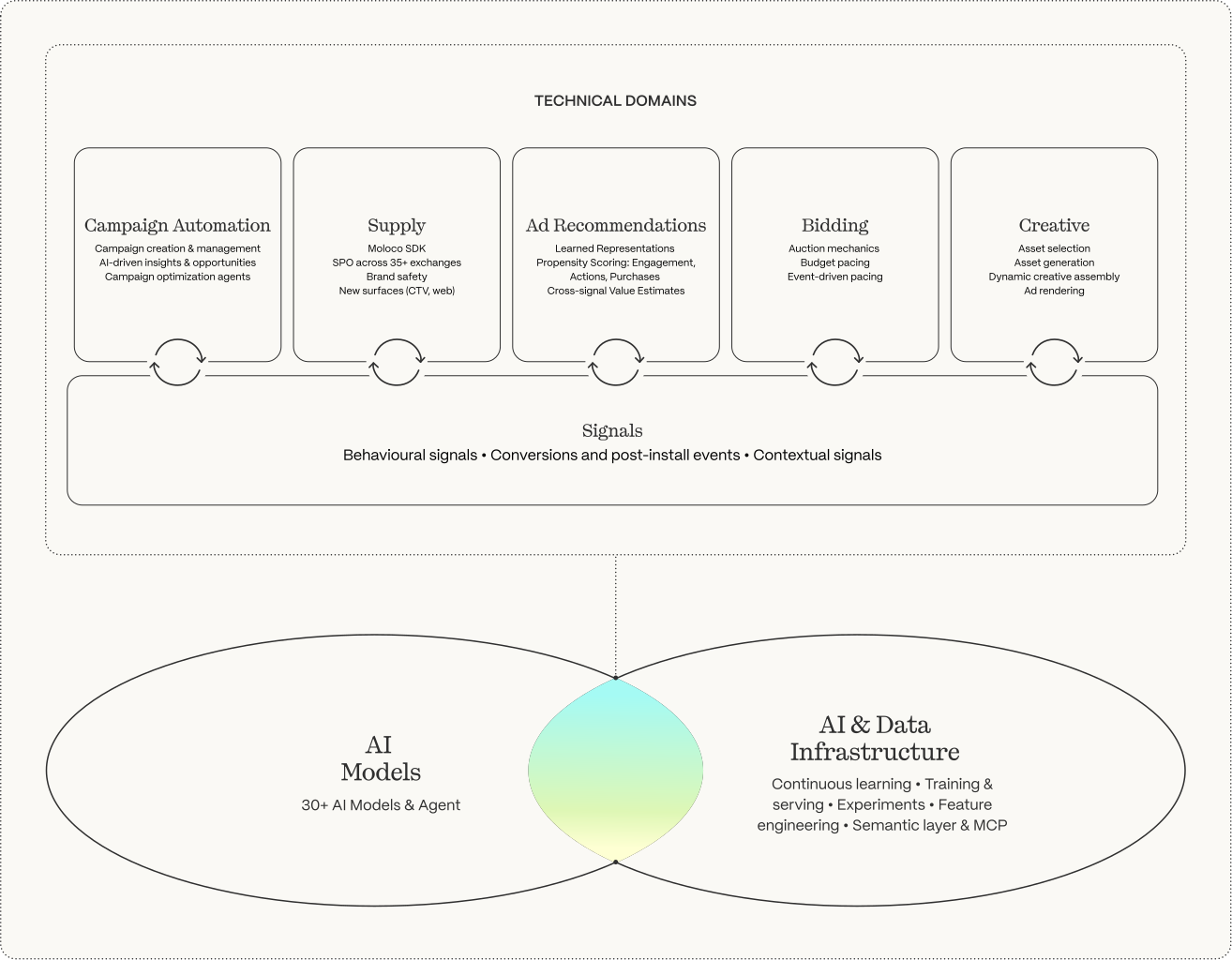
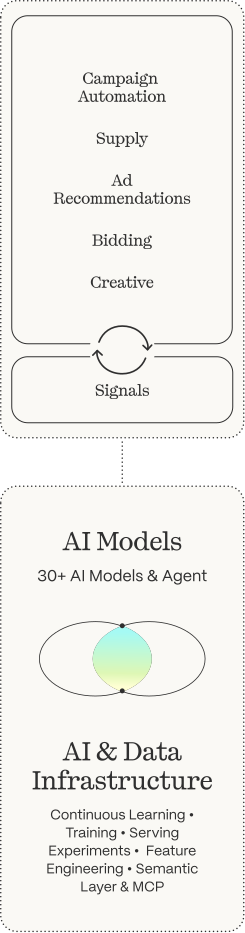
The system is organized into six technical domains, comprising multiple models, agents, and specialized software. Improvements in one domain strengthen performance across the entire system.
How does CARA work?
The six technical domains each address a particular complexity of the open internet — working together to achieve outcomes and compound their gains over time.
Campaign Automation
CARA automates for each advertiser’s outcome, whether that’s maximizing return on ad spend or driving in-app events like registrations or purchases.
CARA agents continually evaluate live campaigns, identify opportunities to improve performance, and surface those insights to advertisers.
Supply
Impressions are rarely exclusive to a single supply path. CARA identifies the optimal one across inventory reaching more than 2 billion daily active users and 2.9 million independent apps, through direct publisher integrations and over 35 exchange connections.
The Moloco SDK gives CARA richer signals about how users interact with ads, helping improve performance for advertisers. It also gives Moloco greater control over creative rendering, unlocking richer ad formats. Each new SDK integration strengthens the entire system. {[data-attribute="init-tooltip"][tooltip-content="<p>Source:<br><br>Daily active users (DAU), for the purposes of this claim, is defined as the average number of unique consumer devices observed across Moloco's integrated exchange partners and proprietary SDK on Android and iOS devices globally per business day. Based on Moloco internal estimate of potential daily user reach across an average of five sample business days in March and April 2026. Each device is assigned to a single country to prevent double-counting; tablets are excluded through deterministic classification using exchange signals and device model matching; and country-specific device-to-user calibration factors are applied to translate device counts to estimated unique users. Number of Apps: Moloco Internal Data; count of distinct app bundles (iOS and Android cumulative total) where Moloco received at least one RTB (real time bid) request in the 90-day period ending April 3, 2026, worldwide. ‘Independent’ refers to apps not operated by Walled Gardens (e.g., Facebook, Instagram, TikTok, Amazon Shopping, YouTube).<br><br>Moloco internal data; count of distinct ad exchanges through which Moloco Ads DSP actively purchased media, worldwide, Q1 2026 (January–March 2026). Excludes Moloco SDK-based inventory to avoid double-counting.</p>"]}
Ad Recommendations
For each impression, CARA predicts how likely a user is to take the actions that matter to the advertiser — from engaging with an ad and installing, to converting, retaining, and spending.
It uses those predictions to estimate the true value of that impression for the advertiser’s objective, helping Moloco make the right recommendation in real time.
Bidding
Most auctions in the app ecosystem operate as first-price auctions — where the highest bidder wins and pays exactly what they bid. That makes precise pricing critical and a complex AI problem.
CARA optimizes bid strategies in real-time under competitive auction constraints.
Getting this right requires deep knowledge of auction dynamics, supply path economics and budget pacing.
Creative
CARA selects and assembles the creative most likely to perform for each user and context.
For the Moloco SDK, CARA models tune individual ad components to create full ad units at impression time — choosing from a vast range of possible combinations.
This allows the creative to adapt from one opportunity to the next, rather than relying on a single combination across the campaign.
Signals
CARA ingests signals from a wide range of advertiser conversion events, publisher interactions, bid requests, mobile measurement partners (MMPs), and SDK activity — with privacy protections built in. These signals arrive in different formats, at different time, and with different levels of reliability.
CARA integrates these signals and identifies the patterns that matter. This enables Moloco’s models to learn relationships across users, products, creatives, publisher contexts, and conversion events — creating a unified intelligence layer that makes every other domain sharper.
Continuous improvement, built in
How does the system compound?
Improvements in each domain strengthen the overall performance of the system and compound and learn from one another. All six domains feed into and learn from a unified Signals layer.
The gains carry from one domain to the next. Better creative selection improves the training signal for Ad Recommendations. Richer Supply signals improve bidding accuracy. More precise bidding generates more outcome data that sharpens predictions downstream.
How does CARA learn continuously?
Systems that learn faster perform better. CARA learns from more than 6 billion events a day on average — including impressions, clicks, installs, and in-app actions.
As new signals arrive, models retrain and updated versions are deployed to production as often as every two hours.
Frequently Asked Questions
What does "compound AI system" mean in practice?
A compound AI system coordinates multiple models, agents, and specialized software. Each component in CARA is built and optimized for a specific domain — like bidding, creative, supply, and so on. The compound architecture means improvements in any domain carry through to others. For example, a richer supply layer sharpens bidding accuracy. Likewise, a better creative selection produces improved training data for Ad Recommendations. These improvements multiply through the system rather than summing independently.
How often are models updated?
Updated model versions are deployed to production as often as every two hours. Real-world outcomes (like conversions, clicks, and engagement signals) flow back continuously as training data. This perpetual feedback loop means the system always learns from the most recent data on what works for each advertiser, user segment, and supply context.
What happens when the user signal is limited or sparse?
Sparse signal is one of the big challenges CARA was built to address. On the independent internet, a meaningful share of inventory carries limited user signals, new users, low-activity app contexts or environments where behavioral history is thin. CARA's sequence-modeling architecture (trained on user event histories across apps) is purpose-built to predict outcomes in these conditions — drawing on representations learned across the full breadth of Moloco's supply and advertiser relationships.
Does CARA power both Moloco Ads and Moloco Commerce Media?
As Moloco’s compound AI architecture, CARA underpins Moloco's entire product suite — although specific technical domains and their configuration vary by product context. Learn more about how the compound AI architecture applies to Moloco Commerce Media here.
What is the role of the Moloco SDK in the architecture?
The Moloco SDK serves two functions simultaneously. First, it integrates with publishers, so CARA directly accesses their ad inventory instead of routing through exchange partners. Second, it gives CARA control over creative rendering on devices — unlocking richer ad formats and behavioral signals that feed back into the models. Each new SDK integration strengthens the entire compound system because the signal it generates improves training data quality across all six technical domains.
