
Your best-performing ad, the one that consistently wins on your biggest channel, may be costing you access to the rest of the internet. A vertical video, for example, can't appear in the banner slot of a news app, the native feed of a weather app, or the playable break in a puzzle game.
As AI platforms have gotten more and more sophisticated, there are nearly endless opportunities across the open Internet to find new users across billions of users and millions of apps. But you need the right formats to reach them. Having full creative coverage, or running the full set of creative formats, lengths, and orientations, opens up so many more surfaces for you to win on.
In an increasingly automated world, creative is arguably the most powerful lever at a performance marketers’ disposal. And creative coverage may just be your untapped superpower on the open Internet.
Why creative coverage wins on the open internet
Providing (and refreshing) a full range of creative formats, lengths, and orientations for each campaign means:
1. You reach more of the internet. The open internet is a wide portfolio of surfaces across millions of apps. If you’re missing landscape video, for example, you’re cutting off access to eyeballs in other important moments as users jump from app to app. The more formats you leverage, the more auctions you can enter, and the more users you can reach.
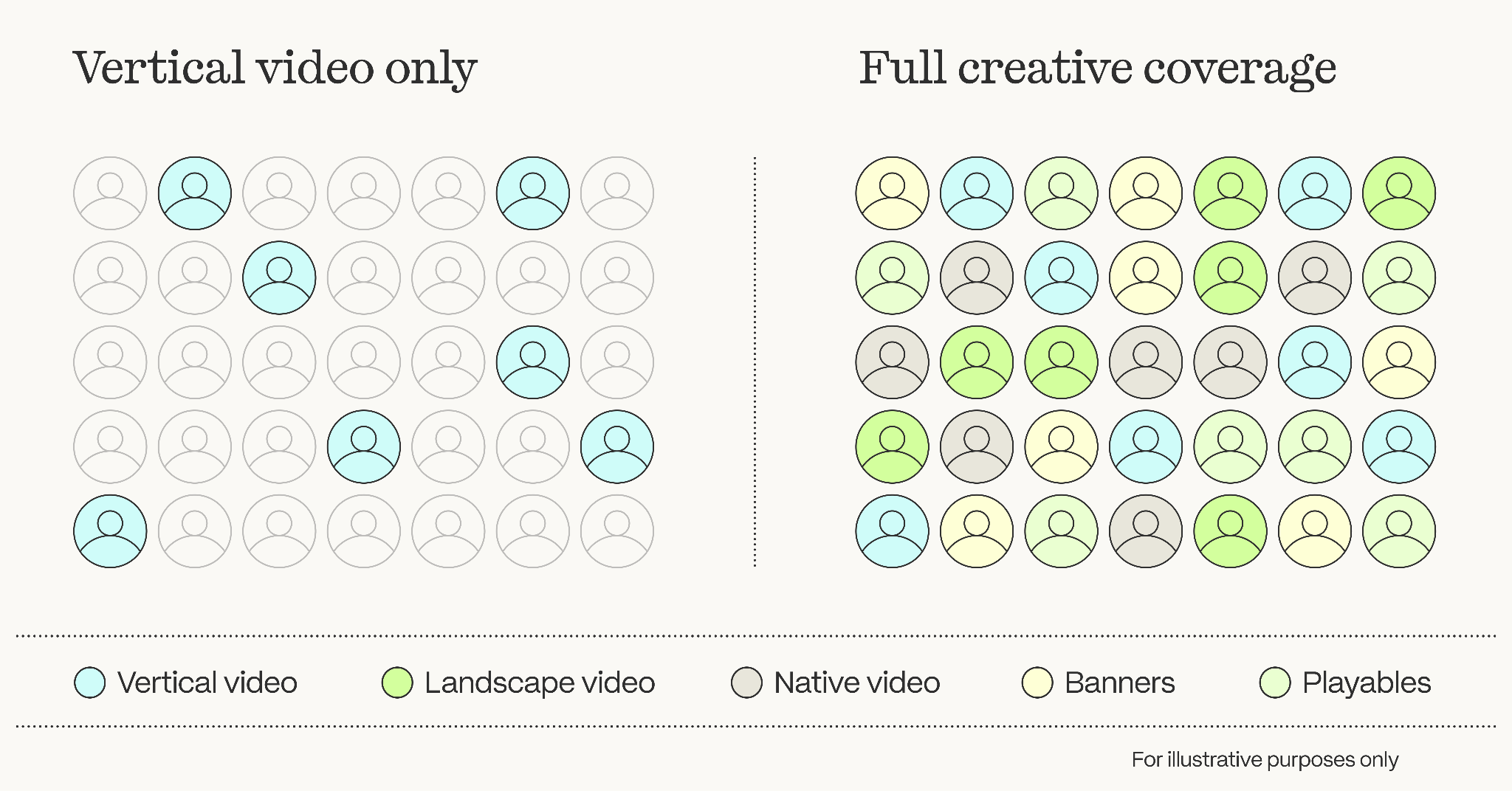
2. The right ad can find the right user. For each impression, Moloco’s CARA (Compound Ad Recommendation Architecture) decides which of your creatives to serve. So CARA doesn't pick your “best” creative and serve it everywhere. It matches a creative to each impression. The ad that convinces a puzzle-game player winding down in the evening is likely not the ad that convinces a news reader at breakfast. With enough variety, CARA gets better at finding the right creative format and asset for each impression, including pairings no human team would think to segment.
This is why a creative leaderboard of top performers can undersell your full library. A creative that looks middling overall can be the top performer for a slice of users.
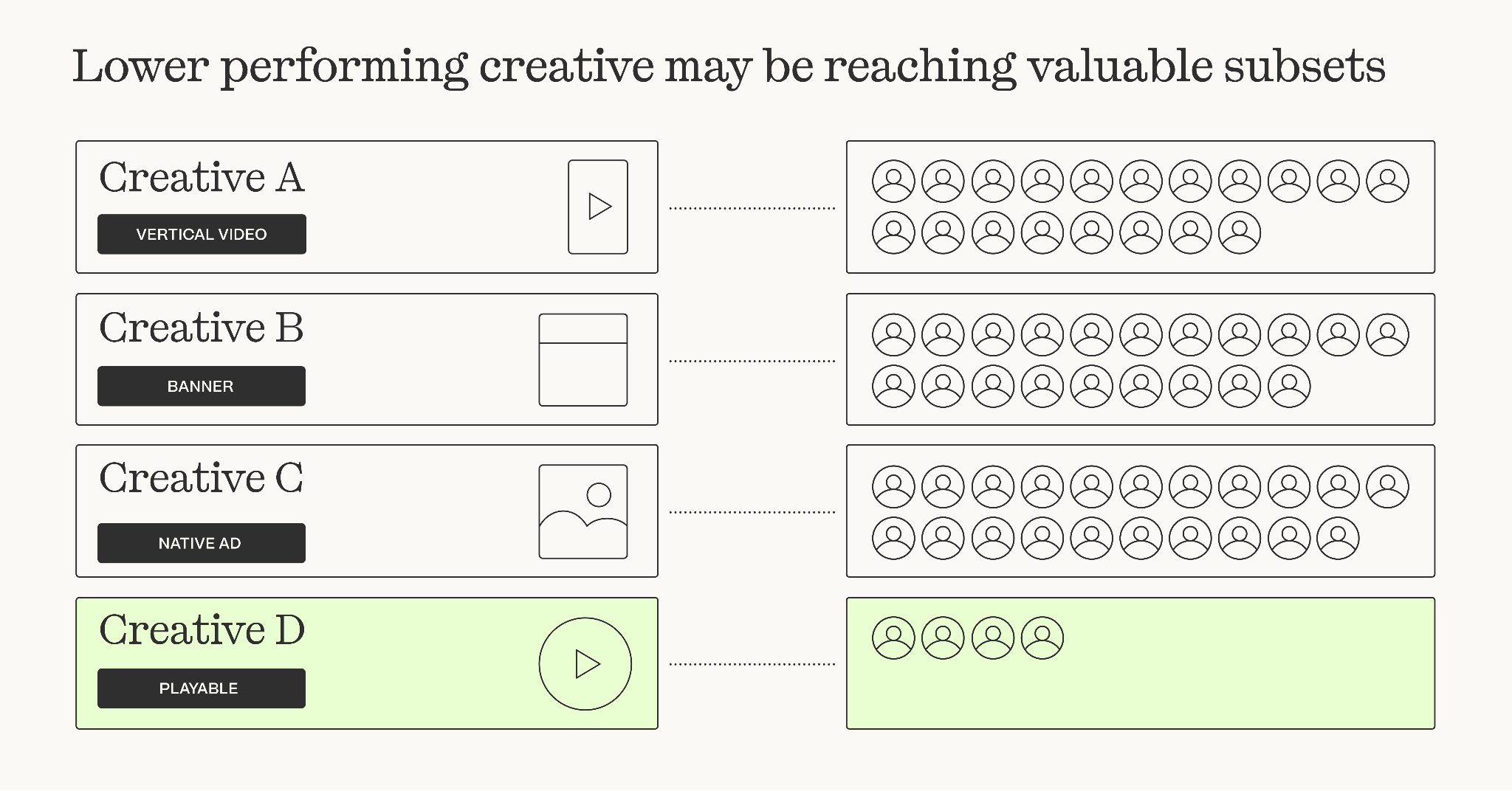
Every format, from immersive full-screen formats to banners, gives you more opportunities to connect with potential customers As users engage with apps throughout their day, they’ll have more and more opportunities to see your ads, and that compounding effect of all the creatives contributes to the click.
3. The compound AI system gets smarter about your audience. CARA is always learning, and more inputs are the fuel. More creative variety means more opportunities for CARA to learn what ads drive action for each user. And as more conversions flow through the system, that signal helps every part of the system get smarter and perform better.
What changes when coverage does
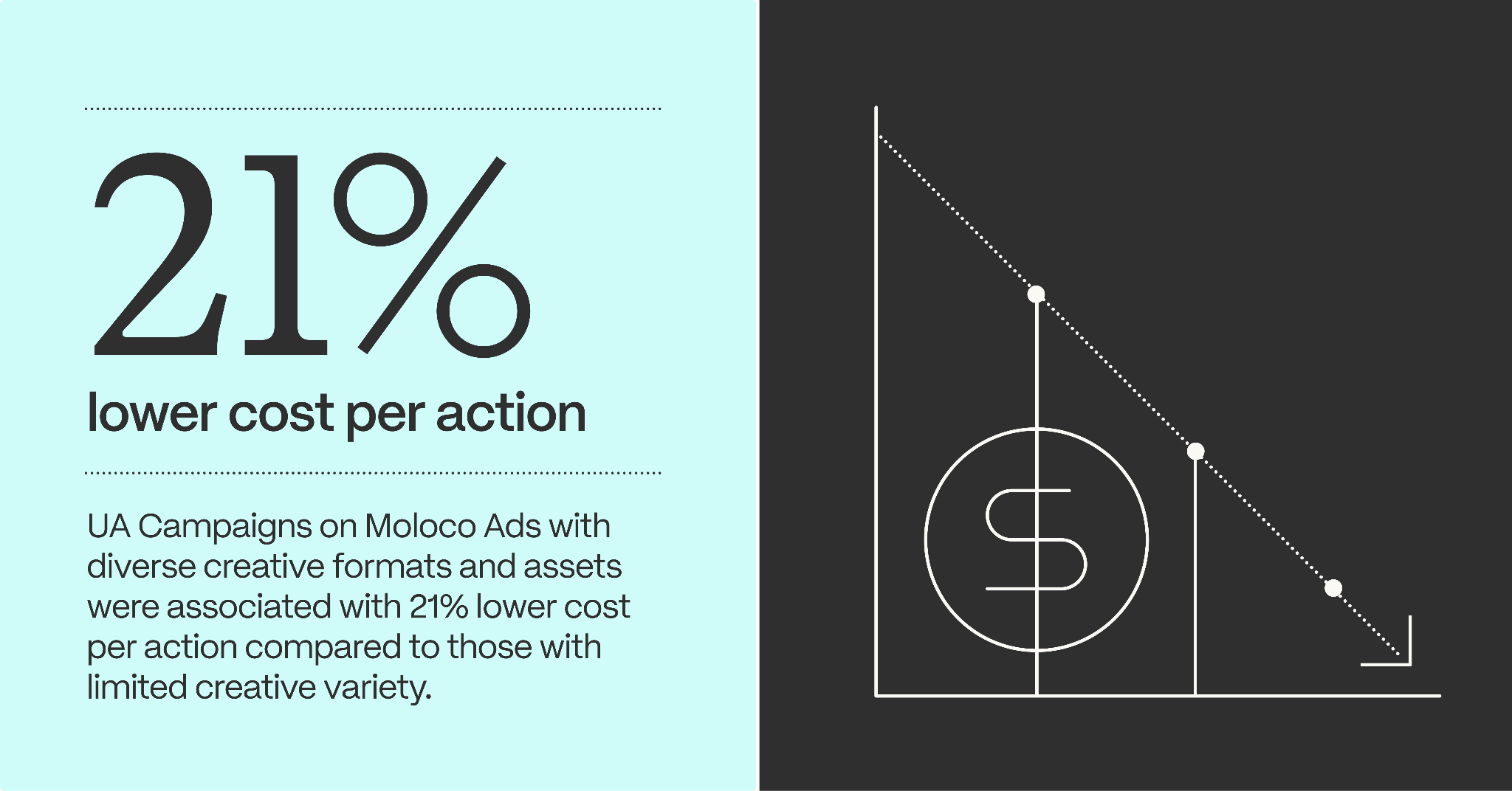
In our analysis earlier this year, campaigns with a diverse mix of creative formats and assets were associated with 21% lower cost per action compared to those with limited creative variety.1
A consumer finance app in the US added native video to its live campaigns, and it grew to earn a large portion of its overall budget. Native placements sit in content feeds and other surfaces that interstitials can’t enter, which gave the system more places to find users. Along with the addition of unattributed revenue events, the change contributed to a 2x increase in its key KPI. The brand has since doubled its spend while keeping performance above target.
An APAC rewards app added playables to a campaign that had none. After making the shift in June 2026, CPI and CPA dropped 30–40% over the next two months even as budgets scaled 80%, with playables becoming the campaign's dominant format.
A health and fitness advertiser in Korea had split campaigns to reduce spend concentration on either image or video. Comparing 8 weeks before and after when budgets were manually allocated in May 2026, the CPA worsened by 43%. What they learned is that in many cases, spend concentration is the result of Moloco’s AI identifying and prioritizing the more efficient creative type.
Best practices for achieving creative coverage
Based on our work across thousands of campaigns, we’ve codified our best practices into a few simple principles:
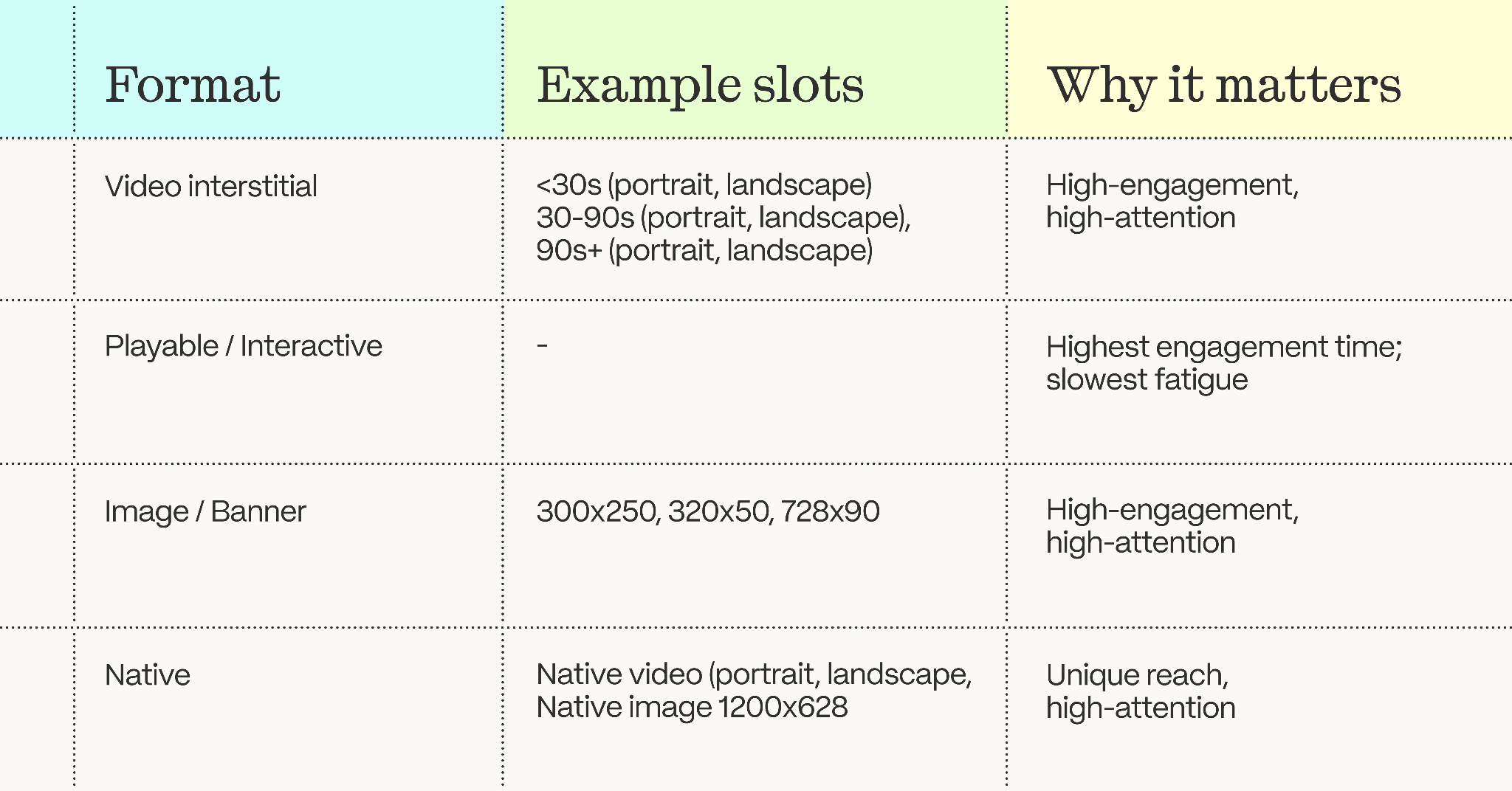
Run all creative formats, including a mix of video lengths, interactive and static end cards, and portrait and landscape assets:
Add new creatives to your live campaign every 1–2 weeks. Add them straight into your BAU campaign and monitor how spend shifts toward them, no separate campaign needed. Keep new batches at roughly 100 maximum new creatives per format per week; larger batches have longer ramp periods.
Give new creatives and formats time to find their place. With each new format or creative, the system explores before it optimizes, serving impressions while it gathers signal. Supply differs by market and category, and budget shifts toward a new format as the system finds wins there. A format that spends little this month is still keeping you present in the auctions where your next pocket of growth may live.
You don't need to cut creative. The AI system throttles true underperformers automatically, and a lower-performing asset may be winning in a context you can't see in the averages.
Measure creatives on the metrics they control. A creative's job is winning attention and action at the impression, so evaluate creatives on installs and share of spend instead of lower-funnel metrics like ROAS. Compare only like with like: vertical video against vertical video, playable against playable.
Creative lifecycles can look different for different campaigns and audiences. If you're not sure where your gaps are, your Moloco team can show you exactly which formats and placements you can add to boost performance today. With full creative coverage, Moloco’s AI can reach further, match better, and improve performance.
Source
1 Moloco Ads Campaign Analysis. UA campaigns only. 72 matched platforms, 896 campaigns total ( 529 High, Creative Score >80; 367 Low, Creative Score <60), Jan 1–Feb 24, 2026. Min. 20 active days and $10K spend per campaign. Creative Score measures the breadth and variety of ad creative formats used within a campaign. Within-platform median ratio reported.
