
It’s not hyperbole to say the role of the UA managers has been transformed. As AI performance channels and systems have gotten better, UA managers can spend much less time on bidding and targeting, and instead focus on being the best at getting the most out of AI.
Today, the biggest levers at your disposal is what you give the AI system to work with: the goals you set, the creative you make, the signals you send, and the way you structure your campaigns.
Here we’ll focus on campaign structure, an often misunderstood and critical component of getting the most out of your campaigns. As AI systems have improved, many advertisers run many more campaigns than they need to. Now, AI systems like Moloco’s CARA perform best when they can learn from as much data as possible in one place. Every extra campaign splits that learning, which limits performance.
Why more signal leads to better performance
The reason campaign structure matters comes down to how CARA works. For every impression opportunity, CARA evaluates many things at once: your campaign goal, the value of a specific user, the best supply path, the right bid, and the creative most likely to get a click.
For advanced AI that need to make decisions in milliseconds, every campaign needs as much signal as possible. When campaigns and signal are consolidated, performance improves in three ways:
- Predictions get sharper. Every conversion in a campaign sharpens CARA's predictions of which impressions will produce results. Better estimates produce better bids, better bids win more of the right impressions, and those impressions produce more conversions to learn from. That learning loop runs on volume: if you concentrate your conversions in one campaign, it compounds; split them across campaigns and each one learns from a fraction of the data.
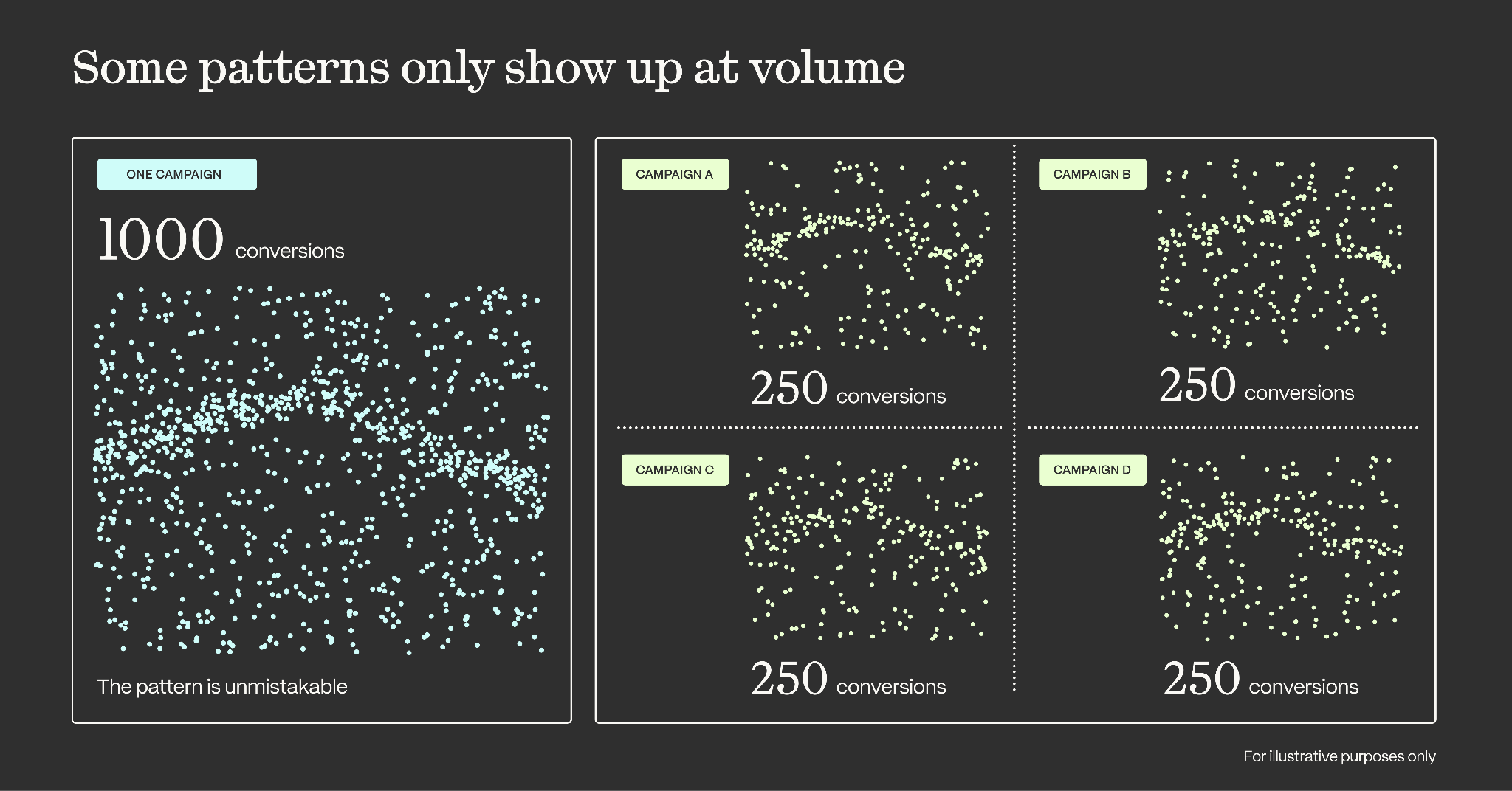
- You avoid self-competition: When two of your campaigns target the same audience and value the same ad opportunity, only one can compete in the exchange. Campaigns with the same app, audience, and optimization event often overlap on the ad opportunities they bid on.
- Performance gets more stable: More conversion volume per campaign often means more confident estimates and steadier bids, with fewer of the week-to-week swings that make a campaign hard to trust. That stability is what can allow you to scale: a consolidated campaign sustains higher scale at similar or better performance because spend flows to the best opportunities Moloco’s AI can find — wherever they are.
How this has played out for our clients
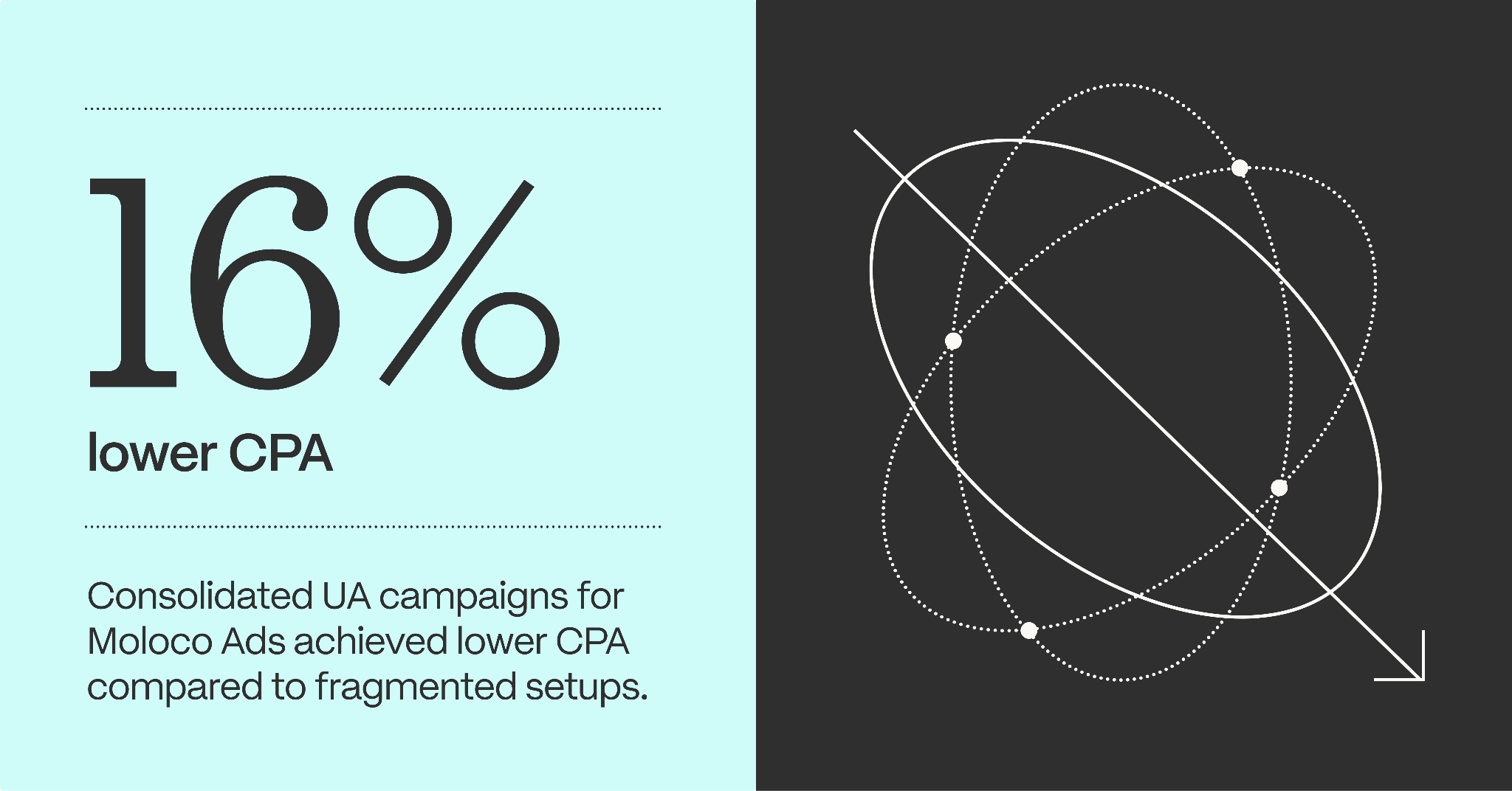
In our analysis early this year, campaigns without duplication issues were associated with a median CPA 16% lower than campaigns with duplication issues, across matched advertisers on Moloco Ads.1
Here’s how it played out with two of our partners:
JustPlay, a play-to-earn games publisher in EMEA was managing nearly 200 campaigns across Android and iOS, running dozens of tests across creative and different campaign objectives. Working with Moloco, they realized the potential in giving each campaign more signal to learn from, and narrowed down a single geo campaign. Initially as Moloco’s AI was learning, costs rose and install volume dipped.
JustPlay held tight and performance improved, particularly on their biggest iOS campaigns. Consolidated signal is what allows Moloco's AI to learn faster, so the models had more to learn from. Compared to June and July of this year, CPMs fell and ROAS was up nearly 4% on iOS in August and September, all while investment has increased nearly 30%.
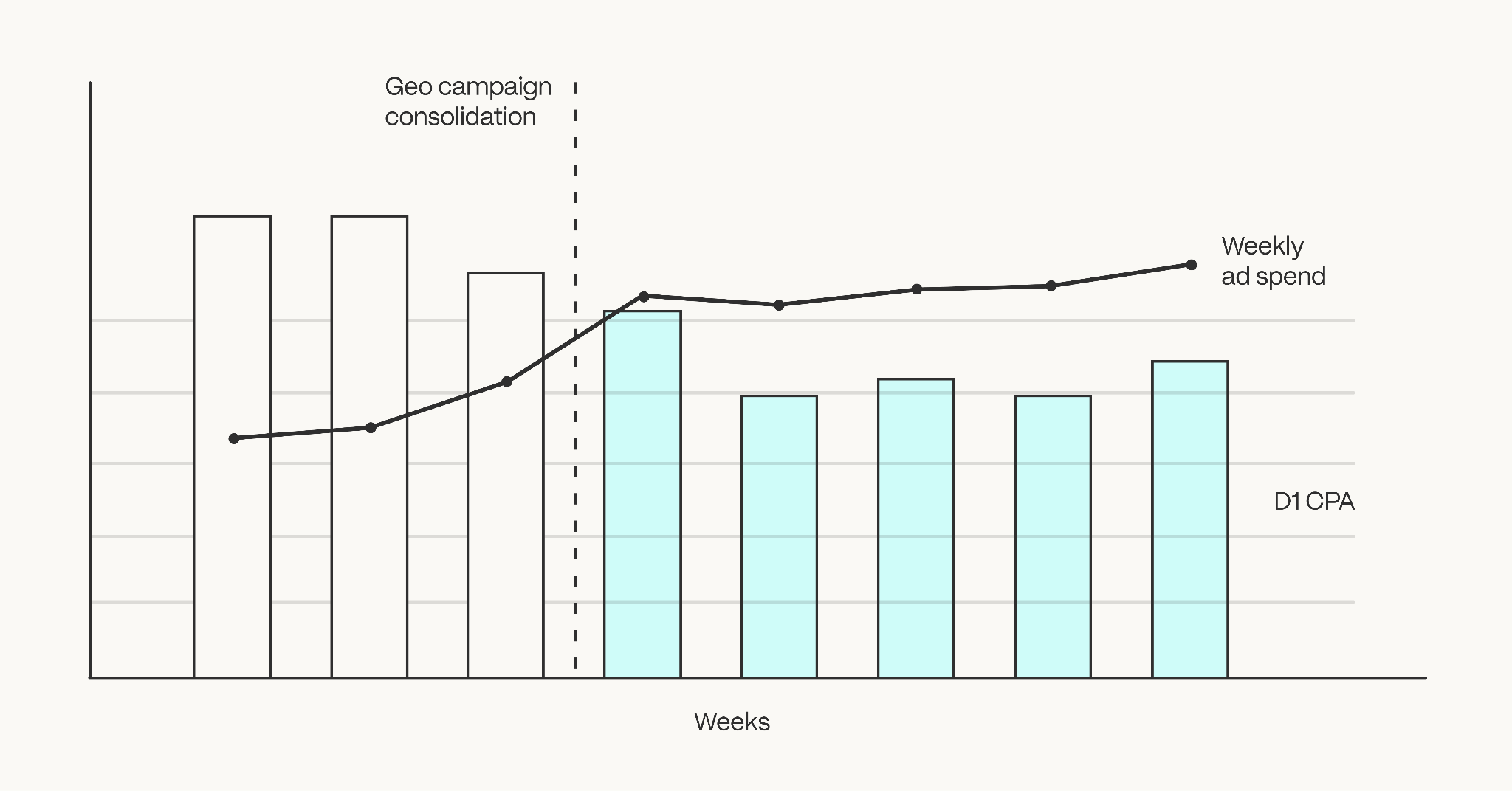
A quick-commerce platform in India was running 9 campaigns all optimized toward the same new-customer purchase event, overlapping on both geography and creative formats. Initially they wanted to boost performance in slower growth geos, but the campaigns were competing against each other, and performance had stalled. The team saw the need to consolidate, but wanted to do it deliberately. Working with Moloco, they consolidated in two waves about three weeks apart: first removing the creative-format duplicates, then reorganizing the rest so no two campaigns covered the same cities.
The results were impressive: Cost per acquisition fell 34% even as weekly spend grew about 50%.
Best practices for consolidating your campaigns
For most advertisers, the simple best practice is one global campaign with a goal aligned to your key business objectives. We’ll never ask you to migrate everything and hope for the best. We’ll work together and follow these guidelines:
Consolidate into your largest campaign, and move the full budget. In order to maximize signal to drive the best performance, the combined campaign's budget should equal the sum of what the separate campaigns were spending. The most common mistake we see is pausing duplicates and shrinking the total budget.
Change one thing at a time. Don't consolidate and scale in the same motion. If the structure change gets tangled up with a budget change, you'll never know which did what.
Give it four weeks. The models incorporate the change within days, but performance metrics are noisy over short windows. Hold budgets, targeting, and creative steady for four weeks before judging, and expect the possibility of a brief dip before things improve.
The bottom line: fewer, stronger campaigns help AI learn faster, allocate budget more efficiently, and perform better. Small setup decisions can compound into large performance gains.
We work together, taking it one careful step at a time. If you're not sure where to start, ask your Moloco team to show you where your campaigns are overlapping today.
Source
1 Moloco Ads Campaign Analysis. UA campaigns only. 54 matched platforms, 1,081 campaigns, Jan 1–Feb 24, 2026. Min. 20 active days and $10K spend. CPA compared within-advertiser between campaigns with and without duplication flags (concurrent campaigns sharing goal, audience, and ≥80% geographic overlap). Median ratio reported.
