

AI Disruption Index: Retail & eCommerce Edition
See where retail and eCommerce brands stand in the AI revolution and how growth leaders are adapting their marketing strategies to win.
Retail in the Breached Quadrant


The Complacency Gap
Senior marketing leaders across industries see the wave coming. In BCG x Moloco’s survey of 283 executives across 15 verticals conducted in October 2025, 67% expect high AI-driven disruption to their consumer journeys. Retail leaders see something different: only 36% share that concern.
The gap runs deeper than general sentiment.
When asked about agentic commerce specifically:
23%
of retail leaders expressed serious concern
15%pts lower than average across industries (38%)
When asked about AI taking over core services:
5%
of retail leaders saw high risk
20%pts lower than average across industries (25%)
About the Research
This report leverages insights from multiple research methodologies conducted with Boston Consulting Group from June to October 2025.
Quantitative Survey
283 marketing leaders (VP/C-level) across 17 verticals and 5 regions, representing companies from $50M to $10B+ in revenue.
Expert Deep Dive Interviews
15 senior executives (VP/C-level) from leading companies across key verticals.
Performance Analysis
App performance data from 3000+ apps with 200B+ downloads, analyzing retention rates, engagement patterns, and acquisition channels (Moloco/Sensor Tower/Semrush).
Retail isn’t just calm about AI disruption. It’s the calmest sector in the study.
BCG’s X Moloco Consumer AI Disruption Index tells a different story. The index scores verticals on two dimensions: the extent to which AI can disintermediate the customer relationship, and the strength of that relationship today. Retail lands in the “breached” quadrant alongside travel and news. A shopper can now ask an agent for a recommendation, evaluate options, and complete the purchase without reaching a retailer's site.
About the Research
This report leverages insights from multiple research methodologies conducted with Boston Consulting Group from June to October 2025.
Quantitative Survey
283 marketing leaders (VP/C-level) across 17 verticals and 5 regions, representing companies from $50M to $10B+ in revenue.
Expert Deep Dive Interviews
15 senior executives (VP/C-level) from leading companies across key verticals.
Performance Analysis
App performance data from 3000+ apps with 200B+ downloads, analyzing retention rates, engagement patterns, and acquisition channels (Moloco/Sensor Tower/Semrush).
Retail has real assets: fulfillment networks, loyalty programs, first-party data. But assets don’t change the exposure score. Either retail leaders see something the index missed, or the disruption will arrive before the urgency does.
Insulated on Discovery, Exposed on Service

The confidence might make sense if discovery were the primary exposure. The data suggests otherwise.
The index breaks AI disruption into two components: discovery disruption, which measures how AI reshapes the way customers find you, and service disruption, which measures whether AI can replace what you actually do. Retail's scores reveal an uncomfortable inversion.
Retail traffic sources, mapped by disruption risk
Low
Medium
High
About the Research
This report leverages insights from multiple research methodologies conducted with Boston Consulting Group from June to October 2025.
Quantitative Survey
283 marketing leaders (VP/C-level) across 17 verticals and 5 regions, representing companies from $50M to $10B+ in revenue.
Expert Deep Dive Interviews
15 senior executives (VP/C-level) from leading companies across key verticals.
Performance Analysis
App performance data from 3000+ apps with 200B+ downloads, analyzing retention rates, engagement patterns, and acquisition channels (Moloco/Sensor Tower/Semrush).
Nearly half of retail traffic (48%) arrives direct, shoppers navigating straight to a site without passing through another touchpoint. A further 23% comes through channels at high risk of AI disruption, including SEO, display, and paid search. That figure is notably lower than for verticals with a heavier reliance on paid search, such as News (39% at risk) and Health & Fitness (40% at risk). Travel sits in a different position: its share of high-risk traffic is similarly modest (26%), but with less direct traffic (40%) to absorb any losses, its buffer is thinner.
Service disruption is a different story for retailers:
About the Research
This report leverages insights from multiple research methodologies conducted with Boston Consulting Group from June to October 2025.
Quantitative Survey
283 marketing leaders (VP/C-level) across 17 verticals and 5 regions, representing companies from $50M to $10B+ in revenue.
Expert Deep Dive Interviews
15 senior executives (VP/C-level) from leading companies across key verticals.
Performance Analysis
App performance data from 3000+ apps with 200B+ downloads, analyzing retention rates, engagement patterns, and acquisition channels (Moloco/Sensor Tower/Semrush).
AI can already replicate core retail workflows, from product comparison and feature explanation to compatibility checking and, increasingly, checkout. Regulatory barriers are likely to offer minimal protection. The data required for these tasks is largely accessible. Agentic commerce models within LLMs directly threaten generic marketplaces, while only retailers with deep loyalty ecosystems, first-party data, and fulfillment capabilities remain defensible.
The problem is the response doesn't match the exposure. Only 32% of retail leaders prioritized SEO on LLMs, and only 55% were building in-house AI capabilities, both below cross-industry averages. Eighty-six percent prioritized first-party data capture, which is the foundation for service-layer defense, but without connecting it to the threat it's meant to address. The building blocks are on the table. The urgency to assemble them isn't.
The Gap is Already Visible

Protocols from Google and OpenAI are standardizing agent-to-merchant transactions. The infrastructure that lets an AI agent discover inventory, verify claims, and complete a purchase is live, and 30% of consumers now say they're comfortable letting AI buy on their behalf.
The experience gap tells you where this lands. A shopper asks an agent for a standing desk that fits a small apartment with good cable management. The agent walks them through weight capacity, height range, assembly complexity. They settle on a recommendation. Then they click through to the product page: a static spec sheet, reviews sorted by recency, and a chat widget in the corner that rarely gets used. The conversation they just had was intelligent. The experience they landed on asks them to start over.
One retail CMO described the shift:
"That initial click [to our website] is not happening because [consumers are] getting the information they need directly [from AI overviews]…

I think the top of funnel is gonna be the highest disruption... but honestly it's full funnel disruption, because even at the bottom of funnel… that journey is being disrupted."
The risk isn't that shoppers stop visiting retail sites. It's that they arrive having already made the decision, with the retailer reduced to fulfillment.
The Asset They are not Using

If service disruption is the real exposure, the natural question is whether retailers have any structural advantage. They do but most are not using it.
ChatGPT serves every vertical, every shopper, every query. Breadth is the product. That’s a strength and a constraint: the economics of a generalist model don’t justify going deep on any single category when you’re optimizing across all of them.
Retailers operate under different math. You hold the post-purchase truth: the returns, the support tickets, the fulfillment exceptions. You know that return rates spike when two specific products are bought together, a bundle incompatibility no review mentions, because you see the pattern across thousands of transactions. You know a “universal” smart home hub has connectivity issues with Ring Gen 2 doorbells because you see the support tickets. You know which mattress actually works for side sleepers with back pain because you’ve tracked which ones come back.
This is one of the drivers for why the index identifies retail as “defensible.” The first party outcome data that reveals what actually works versus what the spec sheet says should work.
But defensible is not defended. One CMO admitted the gap directly: “We don’t even have a customer data platform right now. Our customer data is split up among a bunch of different things... without that, we can’t really use an AI-based re-engagement tool.”
Encoding looks different by category. A home goods retailer turns return patterns into "these two products don't work well together" surfaced before the shopper adds both to cart. An electronics seller turns support tickets into “known compatibility issue” before the shopper makes the wrong choice. A furniture site turns behavioral sequences into guided entry points that cut 200 results to 4.
Each of these stops offering inventory and starts offering intelligence. The shopper comes back because the site understood what they needed, not just what they typed. That’s how retail moves out of the breached quadrant.
How Winners Compound the Advantage
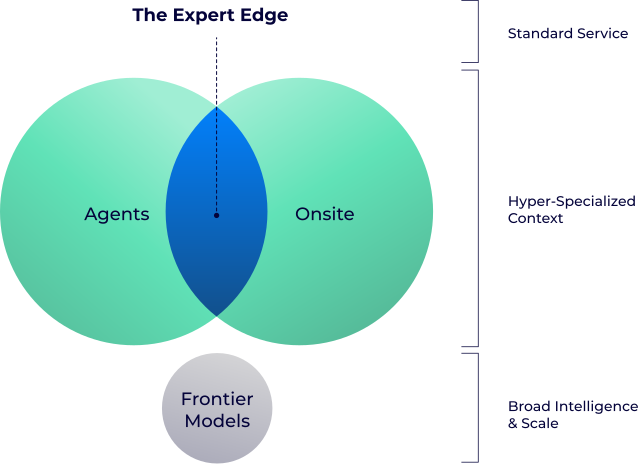
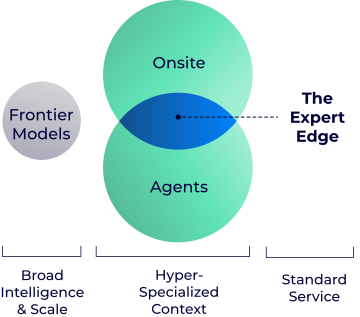
Having the data isn't enough. The advantage compounds only when onsite and offsite work as one system.

Onsite is offense
where you control the experience and hold data no one else has. The goal is building habits strong enough that your best customers skip the agent entirely. When assistance surfaces at moments of friction rather than waiting in a chat widget, when it resolves uncertainty rather than adding steps, shoppers notice. Not consciously at first. But after a few sessions where their questions were anticipated, they start coming directly.

Offsite is defense
where consideration sets form before shoppers reach your site. The goal is visibility without commoditization. Share product attributes freely; they're table stakes. Share outcome-derived insights selectively, the conclusion without the underlying data. Protect the system that generates those insights.
These fronts feed each other. Agent interactions surface intent data that clickstreams never capture: explicit budgets, timelines, use cases, brand preferences. That signal can flow back into onsite personalization, improving the experience in ways that give shoppers a reason to come direct next time.
The same catalog structure powers both fronts. The same outcome data differentiates both. Retailers who see one capability with two expressions will compound advantages faster than competitors who fragment the work across siloed teams.
Retail's customer relationship data suggests the foundation exists. Acquisition strength is solid - around 60% of retailer app installs arrive organically, broadly in line with the cross-vertical average and a sign that most traffic is already earned rather than bought. Sustained loyalty is moderate, with top retail apps retaining roughly two-thirds of users from day 7 to day 30, comparable to the cross-vertical average but trailing stronger categories like FinTech and Media/Streaming.
Platform engagement depth shows the most room to grow: only 63% of time in the vertical is spent on-app versus a cross-vertical average closer to 68%, and that's where media spend can accelerate the strategy. If AI compresses discovery channels like paid search and programmatic display as anticipated, shifting budget toward surfaces where you own the relationship - particularly mobile apps - can reinforce the direct habits that make the onsite advantage durable. The raw material for defensibility is there. The question is whether it gets encoded into the experience before the window closes.
The Learning Window
of retail marketing leaders say they’re prioritizing first-party data capture
expect high disruption
see serious service takeover risk
About the Research
This report leverages insights from multiple research methodologies conducted with Boston Consulting Group from June to October 2025.
Quantitative Survey
283 marketing leaders (VP/C-level) across 17 verticals and 5 regions, representing companies from $50M to $10B+ in revenue.
Expert Deep Dive Interviews
15 senior executives (VP/C-level) from leading companies across key verticals.
Performance Analysis
App performance data from 3000+ apps with 200B+ downloads, analyzing retention rates, engagement patterns, and acquisition channels (Moloco/Sensor Tower/Semrush).
Intent without urgency is a recipe for pilots that stall, roadmaps that slip, learning cycles that never compound.
We expect retailers that are experimenting often will discover which catalog attributes predict conversion, which interventions earn trust, which signals to protect. Whereas retailers that rarely experiment may potentially never learn those lessons. By the time agent-referred traffic reaches a substantial portion of sessions, the defaults will be set: which retailers agents recommend, which catalogs they trust, which data they rely on.
The defaults are forming now.
Over the course of October 2025, BCG x Moloco’s Consumer AI Disruption Index assessed 17 consumer-facing verticals through a quantitative and qualitative study (note that two verticals only participated in the qualitative and not the quantitative portion of the study) of 238 senior marketing leaders across five regions, combined with app performance data from more than 3,200 apps. The full Moloco Readiness Guide includes a diagnostic for retailers seeking to assess their catalog structure, technical infrastructure, and organizational coordination. Full methodology available in ‘The AI Disruption Index: How AI is Reshaping Consumer Discovery’.
